Saturday, December 11, 2010

Sublime?


As my paper progressed, I decided to compare the way that artists depict the sky, and to find a way to determine which depictions could be considered sublime, if not all of them. Along with works by Turner and Friedrich, which I find to be very sublime, I looked closely at the work of Maxfield Parrish.

I don't see Parrish's work as sublime, but I wanted to determine why exactly that is, namely what the difference is between his work and that of the others. During my investigation, I found that those paintings of the sky that I felt were more sublime were those that did not necessarily depict it as it is, but as humans experience it. The Parrish, while incredibly detailed, does not provoke the same awe in the face of the forces of nature as does the Turner.


What do you think? For you, what criteria can be used to label something as sublime or otherwise?

IMAGES

I can't get the images to attach!! Here are the links.

Fragonard, The Swing, 1776
http://upload.wikimedia.org/wikipedia/commons/e/eb/Fragonard%2C_The_Swing.jpg

Degas, The Tub, 1886

http://www.musee-orsay.fr/en/collections/works-in-focus/graphic-arts.html?no_cache=1&zoom=1&tx_damzoom_pi1[showUid]=4041

Degas Sketch

http://johnnyholland.org/wp-content/uploads/edgar.jpg

Chuck Close, Fanny, 1985

http://thepacegallery.com/#/q_title=Now%20Searching:%20fanny&q_keywords=fanny&r_referrer=nav&r_type=keyword&r_details=x_x_x_x_x_x_x_x_x_x_&r_page=x_x_x_x_x_x_x_x_x_x_&r_search=0~q_title=Now%20Searching%3A%20Home&q_searches=6&q_id=1&q_q_1=homepage&q_c_2=Artist&q_q_2=Artist_isPaceArtist%3Atrue&q_c_3=Catalog&q_q_3=Catalog_yearPublished%3A2008&q_c_4=Catalog&q_q_4=Catalog_yearPublished%3A2009&q_c_5=Catalog&q_q_5=Catalog_yearPublished%3A2010&q_t_6=Museums%20Exhibitions%20Search&q_c_6=MuseumExhibition&q_q_6=Exhibition_category%3Acurrent&r_referrer=nav|0|0|0|0|0|0|0|0|0|&p_visible=1&p_type=ArtWork&p_itemName=ArtWork&p_id=2051&p_ids=2051

Robert Ryman, Ledger, 1982
http://www.tate.org.uk/servlet/ViewWork?workid=13058&tabview=image

Let's Play Baseball

http://img.buybabydiaper.com/images/Popular-Lets-Play-Baseball-Super-Sturdy-Picture-Books-Costs_517WSM3Q80L._305_235.jpg

Essay Revisited

So I kind of rewrote my essay (taking some of your advice) so I have to rewrite my post.

I explored the idea of secrets and curiosity scientifically, and found every article basically saying that our curiosity is innate. The more I thought about it, the more mystery because my fascination. We get so preoccupied with mystery, sucked in to books like Harry Potter and The Da Vinci Code. From there, I extrapolated to the idea of art, curious as to why I'm so attracted to some and not to others. Why, when there are many individuals who can precisely replicate a scene photo-realistically with paint, are the artists in the museums people like Rothko and Ryman; more importantly, why do I like Ryman so much more than a photo-realistic oil paint landscape. The answer is mystery. Mystery is ultimately what is most attractive about art and, ultimately, about life. We play hard to get, we research new fields, we step into the shoes of another through community service or acting or psyche. Furthermore, our ability to harness our curiosity further than food and shelter seeking is what makes humans unique.

So I explored the different kinds of mystery in art from Fragonard, to Degas, to Chuck Close, to Robert Ryman. I then looked at the Frost poem "The Road Less Traveled" as suggested, and actually related it back to the good and bad children's books I originally took in for that class.

EVERYONE BE CURIOUS ABOUT LIFE. Life is too short to sit around allowing things to happen to us; we must seize every day and learn something new!

Yah! Happy Holidays
PS. Images in the next post

on the topic of illustrations...

Sooooo these are some really cool illustrations I found online. I think it'd be interesting to find poems to go with each one. I'm not sure what would go with each, but this would be an interesting experiment as far as painting with words: to find what poem, the mood and word choice and images, go with which image. I'm a big fan of all three of these. The one on the bottom right reminds me almost of Allen Ginsberg's "Howl," which is a sensory bombardment, but not nearly as happy and bubbly. Still, if anyone reads this post: http://www.wussu.com/poems/agh.htm Definitely worth checking out. At this point there's not much I can ask about my essay, since I've finished it, but I would issue a challenge to try to find poems to match these illustrations. They have to be cool poems, since they're cool pictures, but anything else goes.

Friday, December 10, 2010

Illustrating poems


I decided to do my paper on the combination of poems and illustrations. I think that this is a unique approach to painting with words because poems can be expanded in two directions: first, poems are meant to be read aloud (excluding concrete poems), as well as read silently. Reading poems aloud adds to their effect. Second, poems can be augmented with illustrations. This expands on their visual aspect, not only the length of lines and quality of words, but also the visual images that the poems present.

William Blake's poems are interesting to look at, because he was an artist as well as a writer. Here's one of his poems from Song of Innocence and Experience, called "The Tyger." Here, his illustrations enhance the poem because they add to the general dark mood, with the red-eyed tiger, sharp, thin branches, and dim colors.

When interpreting someone else's poems, the process is different. What would you suggest as a strategy for doing this?

different approaches to using ruins


I found this bottom painting also by Hubert Robert called "Imaginary View of the Grande Galerie in the Louvre in Ruins." It makes me wonder what the effect of showing such a prominent building in ruins has. Robert's piece contrasts sharply with the top one, by Giovanni Battista Piranesi, called "Ancient crossroads of the via Appia and the via Ardeatina." While Piranesi seems to emphasize the great detail of the ruins and their towering magnificence, Robert instead uses them to create a mood of mystery and sublime melancholy. His building fades away into the haze of the distance, while Piranesi's stays distinct and clear. Also, in Robert's piece, the people and the foreground have more importance than the people in Piranesi's peice do. In his, the clutter of the architecture overpowers the people in it.

What elements do you think ruins bring to both these paintings? What elements, besides the ones I've already mentioned, do you think are used in one but not the other? What should I mention about the paintings that I haven't already? Color? Texture?

Comments

I've been trying to comment a dozen times, but every time I click [Post Comment] the comment evaporates. (If anyone knows how to fix this, please let me know!) So here are my comments:


All causes and all effects.
No college shit necessary to acknowledge it.
Some call it love and some call it sex. Opposites.
Call it what you want, but with one touch and you’re gone, so call in sick.

Human politics, from whispered hushes and distant crushes.
Mental fits breakin’ pencil tips and inkin’ brushes.
Simple rushes.
God makes man, and this is the devil’s finishing touches.

From dukes to duchesses and kings to queens.
From dust to dust, this is the sinful theme.
The scene for crack fiends and gun-packin’ teens
High on vaccines, magazines and saccharine.

From dukes to duchesses and kings to queens.
From dust to dust, this is the sinful theme.
The scene for crack fiends and gun-packin’ teens
High on vaccines, magazines and saccharine.
Lovescream.

Surrealism

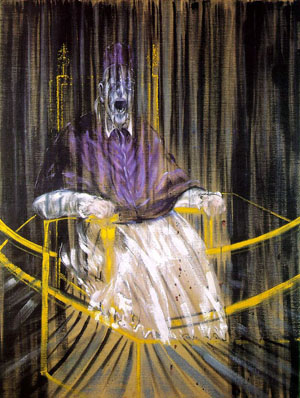
I would have liked to compare this passage from "Walking Around" to Francis Bacon's "Pope Screaming," which is an adaptation of Velasquez's "Pope Innocent X." Do these depictions of religious symbols offend you at all? DO you think both artists had the same intention?

"Still it would be marvelous
to terrify a law clerk with a cut lily,
or kill a nun with a blow on the ear.
It would be great
to go through the streets with a green knife
letting out yells until I died of the cold."

--Neruda

Walking Around

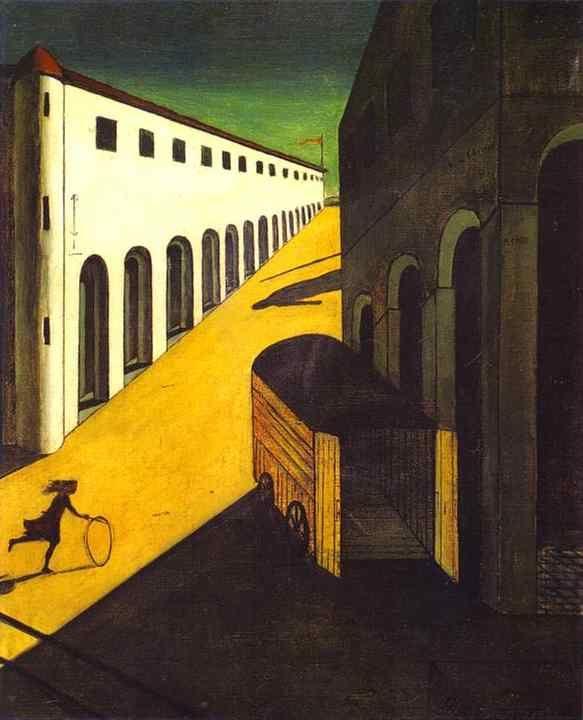
I chose to do a creative piece where I combine vignettes describing my own experiences walking in the streets of Colombia with analysis and description of Pablo Neruda's "Walking Around." Originally, I wanted to compare some sort of visual artwork but that, I decided, would take away from the narrative.It would have been interesting to juxtapose the differing styles of these two pieces (Guernica and Mystery and Melancholy of Street) with their similar moods and how they may relate to the surrealist attitudes in "Walking Around."


vs


Do you get a similar mood from this:

"There are sulphur-colored birds, and hideous intestines
hanging over the doors of houses that I hate,
and there are false teeth forgotten in a coffeepot,
there are mirrors
that ought to have wept from shame and terror,
there are umbrellas everywhere, and venoms, and umbilical
cords."
-- Neruda


Surrealism in Children's books

An interesting subject that I would have liked to address in my paper but didn't find a place for is the comparison between the surrealism employed in children's illustrations (I noticed that few illustrations attempt to convey direct realism, at the very least using a style of representation that made it clear that the images were drawn, as in H.A. Rey's Curious George) and that of the surrealist art movement. Though the main differences would likely be the level of sophistication, depth of meaning and intent involved in the work of art, there are certainly similarities to be found in terms of the way in which they both convey visual ideas. In my paper I discussed the aspects of children's illustrations that distance them from other art, but I think that looking at the ideas and motivation behind surreal elements in some illustrations can serve to bring the genre closer to other forms of art. The next thing to consider would be where is the distinction drawn between nonsense and surrealism?


Alice in Wonderland, John Tenniel
Vs.


Giorgio de Chirico, "The Uncertainty of the Poet", 1913

Could you find this in an art gallery?


Assuming you don't know where it's from, would you be surprised to find the above work in an art gallery? What about this:


Personally, I think I might be more surprised by the latter than the former; the first reminds me of the artwork of the Harlem Renaissance. However it's the latter work of art, a piece by Cy Twombly entitled Souvenir that is more likely to receive attention as a work of art than the former, an illustration from Ezra Jack Keats' children's book, The Snowy Day. For my paper, I'm exploring the distinction between children's book illustrations and other forms of art, including why we generally don't value illustrations as works of art separate of their place in children's literature. I compared Keats' illustration to a Cy Twombly piece in particular because to me it seems reminiscent of something that a child could create (which is not to demean its artistic value), and I find it curious that particularly in the realm of modernism, we can place more value on art that can be likened to that created by a child than on that created for a child. Children's book illustrations serve a unique purpose in supporting the development of a child's mind, but given the beauty and innovation of some of those illustrations I don't think that they should be limited to that purpose. What are your thoughts?

Video to Text Comparison

In most cases of spoken word performances, though  the author of the piece may perform their work many different times in different venues, their work is only meant to be heard once. It is not meant to be repeated to the same people over and over again for them to analyze and pick apart and do close readings—viewings?—of in order to find their own meaning in it. I feel that spoken word poetry is meant to be a personal statement that others can identify with, at times, but the author is not opening up their emotions for discussion. The way they perform it, as the writer, is the only way it ought to be interpreted.


That being said, here  is the link to the video of the performance from which I transcribed the text (watch it! It's only 3.5 minutes long!).
Is it vastly different from what you thought it would be? Did you think it added to the poem? Distracted from it? Did it change the meaning or your interpretation of it?

Music & Painting

The above painting is called Composition VII by Kandinsky, who's quoted to have said,Color is the keyboard, the eyes are the harmonies, the soul is the piano with many strings. The artist is the hand that plays, touching one key or another, to cause vibrations in the soul. He supposedly saw color when he heard music. Not everyone's a synesthesiac, but I think there's value in understanding the relationship between color and music. I've doodled before with a song in mind, letting that song take over my hand. You may be familiar with the Windows Media Player visualization in which random bars or waves are generated based on the song you're listening to. *Questions* How do painters use color to add sound to their painting? Do you think this is effective? Between painting and writing, which is more effective for describing music? What elements would you emphasize if you were to paint a sound?

Silence in Painting

We have adjectives like small, loud, fragrant, sweet, and silky to describe our world, but similes and metaphors are more helpful for this purpose. We can compare _______ with sunset, caramel, just about any "thing" that has a name. But even then, it's difficult to describe visual and tangible things like a leaf or an insect, let alone something more abstract like a feeling. And compared to vision, there are fewer sounds in the realm of hearing we can refer to in a simile.

A writer can use devices like auditory imagery or alliteration (especially if spoken) to describe a sound. While the writer has the advantage of referring to a sound that already exists in reader's memory and prompt the reader to retrieve and play that sound, a painter lacks the kind of auditory, figurative language of a writer. But this doesn't stop them from attempting to visually describe a sound. Munch actually turns his medium's weakness -its silence- to accentuate his point. *Questions* How would you paint a "scream" (or any other sound)? How is sound described in painting vs. writing? Which one do you think is more effective and why?

the mood embodied by the aesthetics of ruins in paintings


Hi guys, I wanted to investigate what effect ruins have in painting. These two paintings ( the top one is called "View of Gothic Chapel in Ruins" by Carl Georg Adolph Hasenpflug; the bottom one is "Architectural Landscape with Canal" by Hubert Robert). It's clear that both these paintings have a distinct atmosphere, and the ruins play an important role in creating this mood. I get a strong feeling of decay and impermanence, but yet I also feel there is a sense of strength conveyed by the stones. There's also a feeling of the sublime, like there's this awesome construction from another time, and the painter's compositions, specifically the placement of the ruins, demonstrates this. I feel there is also an interesting contrast between the architectural and natural imagery in the paintings.

What do you focus on when looking at these paintings? What interests you the most? What would you write about?

Thursday, December 9, 2010

role of the artist in Bartleby

I'm exploring how Melville sees the role of the artist/author and what type of artist he sees as successful. When he wrote Bartleby he had just been forced to accept much harsh criticism about he shift from writing merely what was asked of him to writing great and complicated works like Moby Dick and Pierre. He had receded into himself and defiantly continued writing. Many critics see Bartleby as an autobiographical piece about the trials and sacrifices of being an author. I am interested in looking at how Melville critiques the artist who focuses completely on the hardships of life and of writing and fails to see beyond it to the important questions found in human connections and love. I am looking at the character of Bartleby as a writer who allows himself to be trapped by hardship and forgets how to connect to others. I am also thinking about how Melville would have responded to Edward Hopper's impression of people as lonely and trapped. Would he have said Hopper failed because he could not see the reality of human connection, because he saw only his own solitude? Or would he have praised hopper as a realist?

Capturing Loneliness

I am writing about how Herman Melville in his story Bartleby and Edward Hopper depict loneliness. This painting, Sunlight in a Cafeteria portrays the loneliness of a man and a woman in a city restaurant, attempting to connect with each other but unable to do so. The emptiness of the restaurant, the ominous gray building across the street, the way the figures are turned towards each other without looking at each other, the way the people seem out of place in this city, the blank wall behind the woman, the geometric windows and tables and walls... these aspects of the painting and others evoke loneliness.

I am currently thinking about the light in the painting and how it contributes to the loneliness. Hopper often used light in interesting ways; light is often as important a character as the people it illuminates. His light is often cold and harsh, revealing the flaws of the figures rather than warming or comforting them. How does the light isolate the characters in this painting? What role does it play in depicting their aloneness?

Style Differences


For my paper, I was looking over various articles about the importance of color in illustration, and found these quotes that you might find interesting:

"It is not the form that dictates the color, but the color that brings out the form."
-Hans Hofmann
"The color of the object illuminated partakes of the color of that which illuminates it."
-Leonardo da Vinci
These quotes got me thinking, and I began wondering about the essence of illustration; is it the form (the artistic style-i.e. collage) or the use of color that make a lasting impression? Which method is more effective for the sake of creating childrens' books? Art in general?
The pictures attached are a black and white sketch of a peacock by an anonymous artist and a peacock by Eric Carle. Both pictures illustrate the same thing. Which picture is your favorite and why? What roles do style and color play in your decision?

Illustrators' Images


Oops! I uploaded the images incorrectly; here are the pieces that go with my article on Eric Carle and Ezra Jack Keats. The first one is actually the Keats piece, rather than the second.

The Written Spoken Word

Is spoken word poetry meant to be written down? When it is, can the same meaning be gotten from the words without the visual and phonic aspects? 


As someone who attempts to be somewhat knowledgeable about spoken word poetry, I've often wondered exactly what its true purpose is and what makes it so different from written poetry--if it is different at all, that is. Since spoken word poetry is meant to performed rather than read on a page, I decided to focus my paper on whether or not it should  ever be written down for an audience to read. 


Take for instance this transcription* of a spoken word piece (I will post the video later for your comparison, but first, just read this): 


I am your puppet
You are my iron lung
I’m mommy’s little girl

My head is hollow because you said,
“Pretty girls don’t need minds,
Just a man they can
Leech themselves onto”
You were always churning me out to be a soft kind
Never could hate
Or love kind,
Why don’t I just work
At the pharmacy kind—
I don’t want to be kind,
I want to be generous
I have glass eyes that never close so I can’t hide behind the blinding flash of your camera
Constantly in my face
click-click-click
I can’t wick, this is sick
I need to get out
Mommy, when you told me that
After a certain amount of water the grass starts to brown,
I went out and tried to give the lawn a spray-tan
See, I‘d rather die brown and drunk than green and thirsty

I am your puppet
You are my iron lung
I’m mommy’s little girl

My skin is wooded and grainy from your chemical bleaching balms [?] and firming creams
And I can feel
My internal flesh burning as my body is yearning,
Starving for nourishment
But mommy,
You don’t cook anymore
Because you said I don’t need to gain
Another five pounds
Instead, you take me out in public on a leash
After forcing my torso into a corset
Stifling each breath
As I attempt to be Disfigured Barbie
But at least
This is a pattern
And I’m all
About rhythm
Because my breathing
Is the rhythm
My blinking is
The rhythm
And the nurse in the [?] promising to heal me taps
A rhythm
And did I ever tell you
I like to listen to music
Real soft
Because then,
I think it’s coming
From me

I am your puppet
You are my iron lung
I’m mommy’s little girl

I have hinges in my legs, arms, and especially my neck so I can,
“Yes, mother,” “never,” “no, ma’am,”
To the dictator of my household
But you always were the nurturing kind
Except for 17 years, I’ve been trapped
Pumped to life by an iron lung,
My neck elongated like I’m ‘bout to be decapitated
And the metal working
Away at my soft, soft body
Churning, pumping, contracting
‘Cause you know I can’t
And if for a little while I start to feel big
I will always fit
Within your cold, hard embrace
You watch too close
Your depiction of me
Will always be unsatisfactory,
One disappointment after another
I’m sorry mother
Maybe if I was made of plastic I could fit into your world
But I am human
This is real flesh
This is real body
This is real mind
I am smart,
I don’t need to front behind beauty
I do not fit in themes,
I bleed them
I do not follow dreams,
I lead them
I do not apologize
I realize

I cannot be your puppet
You are not my iron lung
‘Cause you are not my master


 Is it really possible to get the true meaning of what the speaker/author is trying to say from just looking at this transcription? Yes, these are the same words being said, but I feel that the performance aspect introduces the reader to a new level of understanding. The video will be coming soon!

*I did this transcription myself after watching the youtube video many times. There are a few words I couldn't understand. They are indicated by: [?]